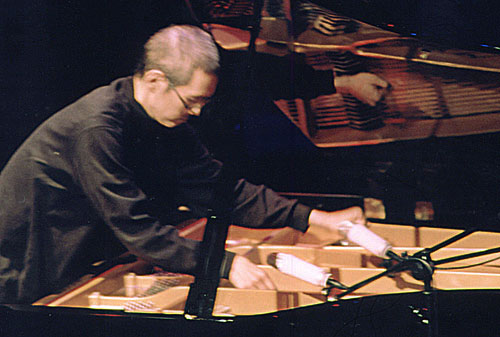
Glenn Horiuchi plucks the piano strings during his performance of Issei Spirit Saturday, January 22, 2000. | ||
He Be Illin'Pianist / shamisen improviser Glenn Horiuchi, battling terminal cancer, rises to the occasion. By JEFF LIUThe music was moving; the words both touching and inspirational. But if there's any way to express Glenn Horiuchi's contributions--musical or otherwise--it would be the way in which he touched so many people. On Saturday, Jan. 22, many of those people came to Little Tokyo from San Francisco, his hometown of San Diego and even as far as Atlanta, Georgia to hear and jam with the pianist shamisen player in a tribute concert celebrating his work, spirit and Life. Horiuchi was diagnosed with terminal colon cancer last August. His thin frame and peppery hair showed signs of physical struggle from the bombardment of chemotherapy treatments. But instead of dwelling on what very well could have been his last public performance, the 44-year-old musician / composer broke the ice and roused the audience at the Japan America Theater with his comedic charge. "Actually, I got news for you," he revealed to the 420-plus attendees. "It's a secret, but you know, we're all terminal. I don't know anyone who's gonna be here forever on this planet." |
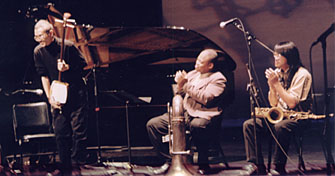
William Roper, center, and Francis Wong are among the musicians and friends who ventured to Little Tokyo to play and celebrate. | |
|
In between sporadic fits of laughter, Horiuchi spoke at length about his compositions and the background for his music. His involvement as a community activist in the National Coalition of Redress and Reparations, the 1982 hearings held by the Commission on Wartime Internment and Relocation of Civilians and the many testimonies influenced him greatly, helping the Sansei find a voice in his music. "The kind of stories that happened in those days and the kind of sharing and opening up was something that's just hard to talk about unless you were there. But it was pretty amazing," he said. "It was kind of a healing and unity and standing up for oneself that I don't think the Japanese American community could ever be the same after that." Horiuchi joked that he was never the same either. In 1989, he released |
"Manzanar Voices," on Asian Improv Records. One year later, he wrote "Poston Sonata," a four-part piece dedicated to the San Diegans interned at the Poston, Ariz. camp, whom he worked closely with during the campaign for redress and reparations. At the Saturday concert, Horiuchi played the last movement in "Poston Sonata," titled "Celebration," along with shamisen master Lillian Nakano, saxophonist Francis Wong, and William Roper on tuba. And celebrate they did. In a piece which commemorated the pending redress victory in 1991, Horiuchi gave a powerful performance, leaving all traces of illness in the dust.
On the shamisen, Horiuchi's style is likened to Omar Santana or Jimi Hendrix on the guitar. From top to bottom, he utilizes every part of the three-stringed instrument: his finger sliding up and down the neck, rocking vibrato, and then slapping the rice-scooper-like pick against the box.
| |

|
Return to: Minami Pictures 2001
|